Guide
The EICR, explained.
An Electrical Installation Condition Report is the document that says whether your wiring is safe. Here is what is in it, what the codes mean, who has to have one and when, and what it costs.

What an EICR is
An EICR is an inspection of the fixed electrical installation in a building: the consumer unit, the cables in the walls, the sockets, switches and light fittings, the earthing and bonding. It is not a test of your appliances. A registered electrician inspects what can be seen, tests what can be measured with calibrated instruments, and writes a report that lists every departure from the current wiring regulations with a code saying how serious it is.
The report ends with one of two verdicts: satisfactory or unsatisfactory. Satisfactory means the installation is safe to keep using until the next inspection date on the report. Unsatisfactory means at least one item needs fixing before it can be called safe.
Who needs one, and how often
- Landlords in Wales and England: a satisfactory EICR at least every five years, before a new tenancy if the last one is older, a copy to the tenant within 28 days, a copy to the council within 7 days if asked, and any C1, C2 or FI resolved within 28 days with written confirmation to the tenant.
- Homeowners: recommended every ten years, when buying a house, after a flood, or when anything about the electrics worries you. There is no legal duty, but a mortgage lender or insurer may ask.
- Buyers: the surveyor's report almost always says "an electrical inspection is recommended". That means an EICR. Done before exchange, it is a negotiating document; done after, it is a to-do list.
The codes
Every observation gets one of four codes.
The code, not the number of observations, decides whether the report passes. One C1 or C2 anywhere makes it unsatisfactory. Twenty C3s do not.
C1
Danger present
Risk of injury right now. The report is unsatisfactory and we make it safe before we leave, with your agreement.
Typical: Exposed live conductors, a cracked socket showing live parts, a bare cable in a loft.
C2
Potentially dangerous
Not a risk this minute but could become one. The report is unsatisfactory and the item must be fixed; for a rented home, within 28 days.
Typical: No RCD protection on sockets, missing earth bonding to gas and water, a damaged consumer unit.
C3
Improvement recommended
Does not meet current standards but is not dangerous. The report can still be satisfactory. Worth doing when convenient.
Typical: No RCD on lighting circuits, an old plastic consumer unit, missing circuit labels.
FI
Further investigation
Something we could not test or access, or a result that needs more work to understand. Counts as unsatisfactory until resolved.
Typical: A circuit that could not be identified, a junction box we could not reach, an unexpected test reading.
Checklist
Is your fuse board safe? Six things to look for.
Open the cupboard, look at the board, do not take the cover off. Match what you see against the list. It is not a substitute for an EICR, but it will tell you how urgently you need one.
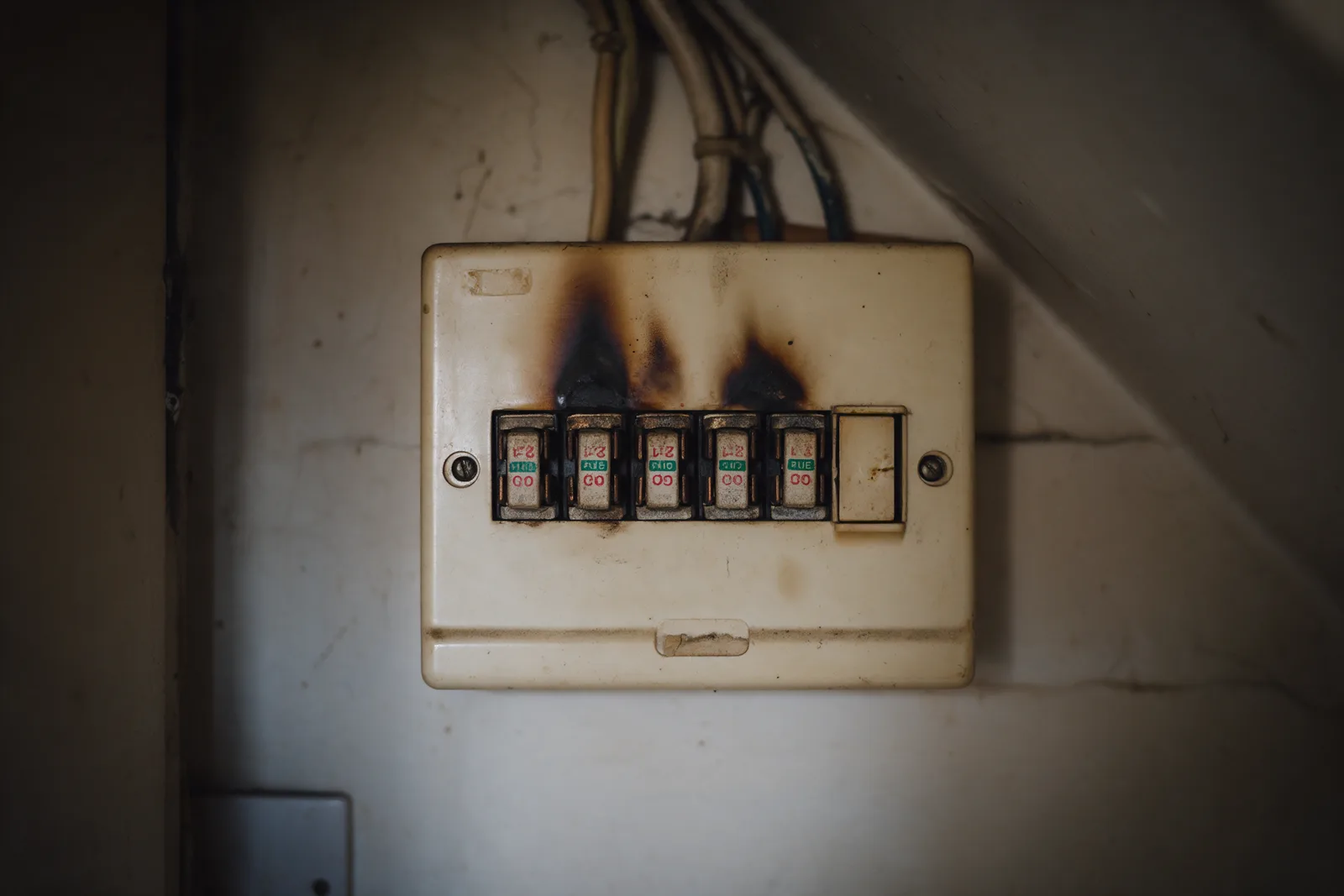
- Rewirable fuses (fuse wire on ceramic carriers)Pre-1980s. No RCD protection. Upgrade.
- Wooden back board or a cream Bakelite boxLikely 1950s to 1970s. Upgrade, and expect to find other things.
- One RCD covering everything, or none at allA single fault trips the house, or nothing trips. RCBO board recommended.
- Plastic consumer unit fitted before 2016Not dangerous in itself but an EICR will note it as C3. Fine to keep if the rest is sound.
- Scorch marks, buzzing, or a warm front coverLoose connection. Ring us today; do not wait for the EICR.
- Metal board with RCBOs, labelled, with a test dateCurrent standard. Test the RCDs with the button every six months.
What happens on the day
- Walk-round and board inspection. We look at the consumer unit, the earthing, the bonding to gas and water, and the general condition of the accessories in every room.
- Dead tests. Power off, circuit by circuit: continuity of protective conductors, ring circuit continuity, insulation resistance, polarity. This is the part where the power is off, in bursts of five to twenty minutes.
- Live tests. Power on: earth fault loop impedance at the board and the furthest point of each circuit, prospective fault current, RCD trip times.
- The report. Written up the same day, every observation coded, with photographs where they help, emailed as a PDF. We talk you through it before we leave.
- Remedials, if needed. Quoted separately so you can shop around. If we do them, the retest is free and the satisfactory report follows.
What it costs
Fixed prices including VAT and the PDF report: £139 for a flat or two-bedroom house, £169 for three bedrooms, £219 for four or more. Landlords with several properties get a portfolio rate and a single reminder diary. See the price list or book an EICR.
EICR questions
Is an EICR a legal requirement?
For rented homes in Wales and England, yes: a satisfactory report every five years, a copy to the tenant within 28 days and to the council within 7 days of a request, and any C1 or C2 fixed within 28 days. For owner-occupied homes it is recommended every ten years and when buying.
How long does an EICR take?
Two to four hours for a house, depending on the number of circuits and how accessible things are. We ask that the loft hatch, the consumer unit and the outside sockets are reachable.
What does an EICR cost?
£139 for a flat or two-bedroom house, £169 for three bedrooms, £219 for four or more. Fixed, including VAT and the PDF report. Remedial work is quoted separately.
Can you do the remedial work?
Yes, and the retest is free if we do. The quote is separate from the report so you can get other prices; about three in four landlords have us do it because the retest costs nothing and the diary already has us.
Do you issue the certificate to my tenant and the council?
We email the PDF to you the same day. You send it to the tenant; we can copy them in if you ask. If the council requests it, you have seven days, so keep the PDF where you can find it.
Book an EICR.
Fixed price, calibrated tests, PDF the same day, and a plain-English walk-through of every observation. Landlords: we remind you four months before the next one is due.