Fencing
Closeboard and panel fencing
Garden and boundary fences built bay by bay: featheredge on arris rails, or heavy panels in concrete posts.
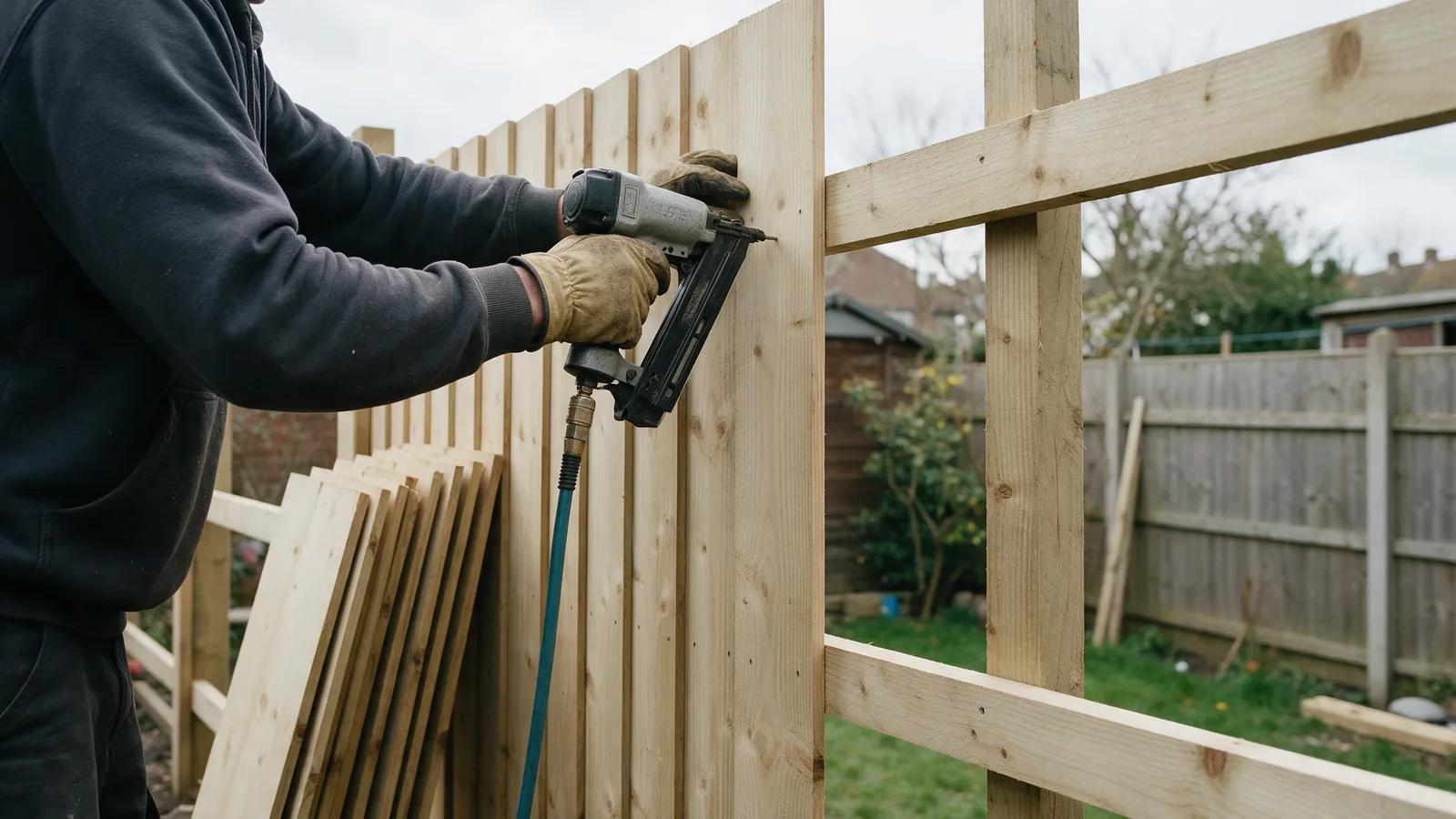
Back gardens and boundaries, four to six feet, from £58 a metre
Two thirds of the fences we put up are a back-garden boundary between two houses, six feet high and somewhere between eight and thirty metres long. Most people ask for panels and end up choosing closeboard once they have seen the price difference over twenty years, not over one summer.
Closeboard is built in place. Posts go in at 1.83 metre centres, 600 millimetres into the ground in concrete, three arris rails are morticed into each post, and the featheredge boards are nailed on with a 25 millimetre overlap and two galvanised nails a rail. A gravel board along the bottom keeps the boards off the soil, and a capping rail on top keeps rain out of the end grain. Because every board is fixed on its own, a broken one is a ten-minute repair, and a gale has nothing flat to push against.
Panel fencing is quicker and cheaper: heavy-duty lap or featheredge panels slotted into slotted concrete posts, on a concrete gravel board. The posts last as long as the house. When a panel is damaged in twenty years, you lift it out and slot a new one in. What we do not fit is the thin dip-treated panel sold at the garden centre for twenty pounds; they last four or five winters on a Caerphilly hillside and then they are back on the lawn.
Every job starts with a survey. Lowri walks the line with a measuring wheel and a steel probe, looks for drains, roots, a neighbour's wall footing and anything else that will stop a post going down, and checks which side the boundary is on. The written price that follows is fixed: if the ground is harder than she thought, that is our problem.
What is included
- A free survey and a written fixed price
- Pressure-treated timber, Use Class 4 for every post
- Posts set 600 mm deep in concrete
- Gravel boards so no timber touches the soil
- The old fence taken away and recycled, if you want it
What it costs
Closeboard from £75 a metre at four feet and £95 at six; panel fencing from £58 to £70 a metre, supplied and fitted, old fence taken away at £8 a metre. The fence estimator works out a range for your length, height and style; the survey sets the fixed price.
Questions about closeboard and panel
Which side of the fence faces me?
By custom the good side faces the neighbour, but on your own boundary it is your choice. Closeboard looks much the same from both sides; we always ask before we start.
Do I need planning permission?
Not for a fence up to two metres high on a back boundary, or one metre next to a road or footpath. Over that, or on a listed building or in a conservation area, ask the council first.
Concrete or timber posts?
Concrete for panel fencing, always. For closeboard we use 100 mm timber posts set in concrete, because the rails are morticed into them; a concrete mortice post is available for £9 more a bay.
Book a free survey and get a fixed price in writing.
Lowri measures the line, probes the ground and checks the boundary, and the written price follows within two working days. It does not change once you have signed it.