Services
Penetrating damp repairs
Finding where the rain gets in, fixing the outside first, and letting the wall dry before replastering.
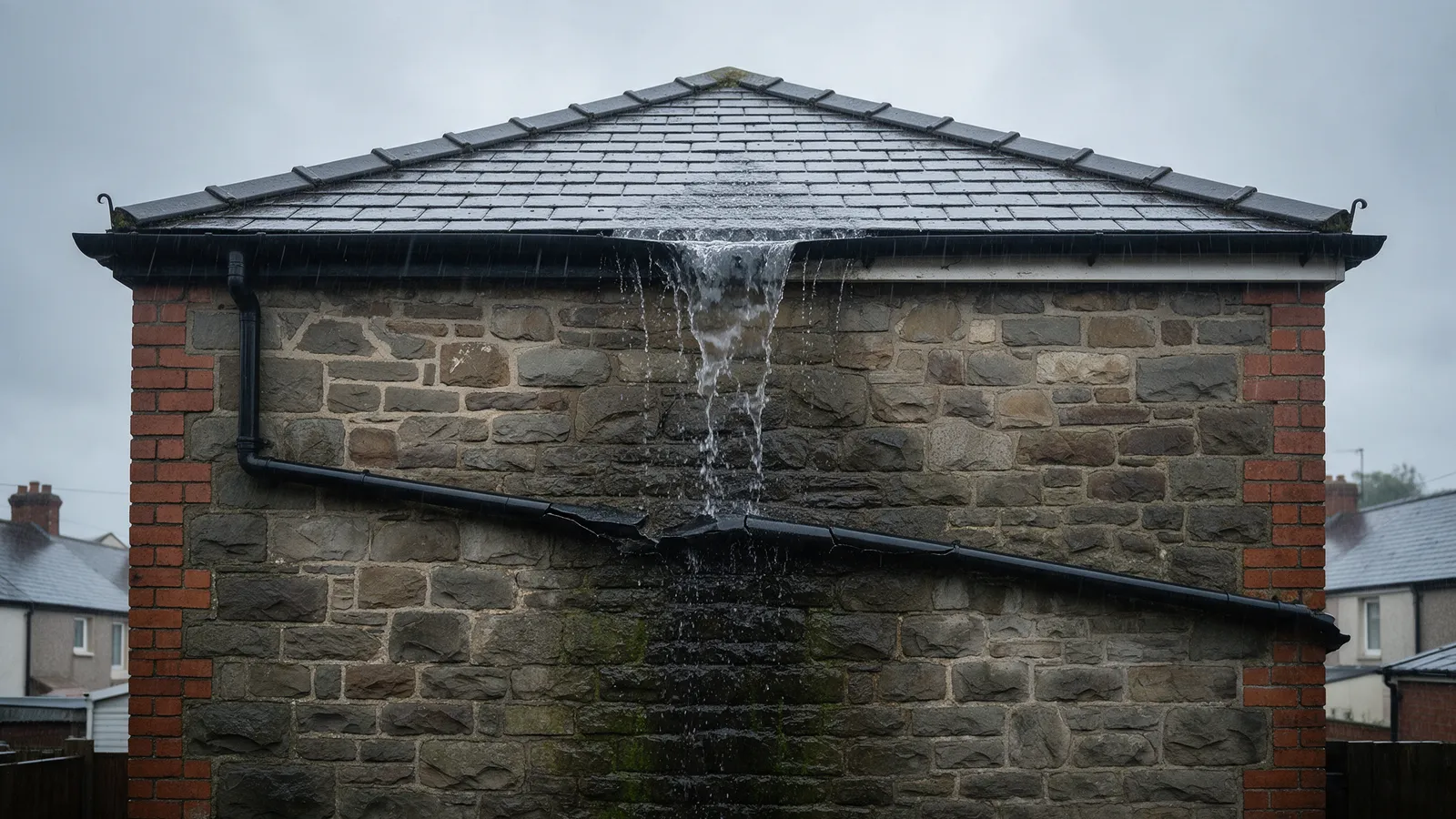
Repointing from £60 a square metre, priced after a survey
Newport sits in the path of the wet south-westerlies off the Bristol Channel, and the old solid stone and brick walls in Maindee, Pillgwenlly and Baneswell take the rain side-on. When a patch appears on an inside wall after a wet week, the answer is almost always on the outside.
We trace the water: gutters and downpipes, cracked render, open mortar joints, failed sills, a chimney flashing, the junction with a neighbour's extension. A thermal camera on a cold day shows the wet patch from outside as well as in.
Repairs are done in the right materials. Old solid walls are repointed in lime mortar, not cement, so they can breathe and dry; cracked render is cut out and patched, and blocked or broken downpipes are replaced. Gutter and roof repairs go to a roofer we trust.
Once the water is stopped, the wall needs time. We come back to take readings and only replaster when it has dried, usually with a breathable lime plaster.
What is included
- The water traced outside, not guessed
- Lime mortar on old solid walls
- Render, sills and downpipes repaired
- Readings again before replastering
- Breathable plaster where it is needed
What it costs
Repointing in lime mortar from £60 a square metre; render repairs, sills and downpipe replacements priced after a survey. Every treatment starts with a survey, because a survey decides what, if anything, needs doing.
A survey decides
Questions about penetrating damp
Should I seal my brickwork with a water repellent?
Sometimes, on sound brick, after the pointing is right. Sealing a wall with failed pointing traps water in it.
Why lime and not cement?
Cement is harder and less porous than old brick and stone, so the water leaves through the bricks instead, which then crumble. Lime lets the wall dry through the joints.
Do you do cavity wall problems?
Yes: bridged cavities and wet cavity insulation show up as damp patches too. We find them with the thermal camera and a borescope.
Not sure what it is? That is what a survey is for.
An hour on site, outside first, with a meter, a hygrometer and a thermal camera, and a written report in three working days. About a third of our reports recommend no work by us at all.