Belts from white to black, the minimum time in each, what is examined, the fees, and the calendar with spaces
The grading system
How belts work at the club: ten kyu grades from white to brown and then dan grades for black, each with a minimum time in grade, a syllabus of what is examined, and a grading in front of three black belts on a dated Sunday with a fixed number of places. Kids £25, adults £30, black belt £120, belt and certificate included. Nobody grades until their instructor puts them forward.
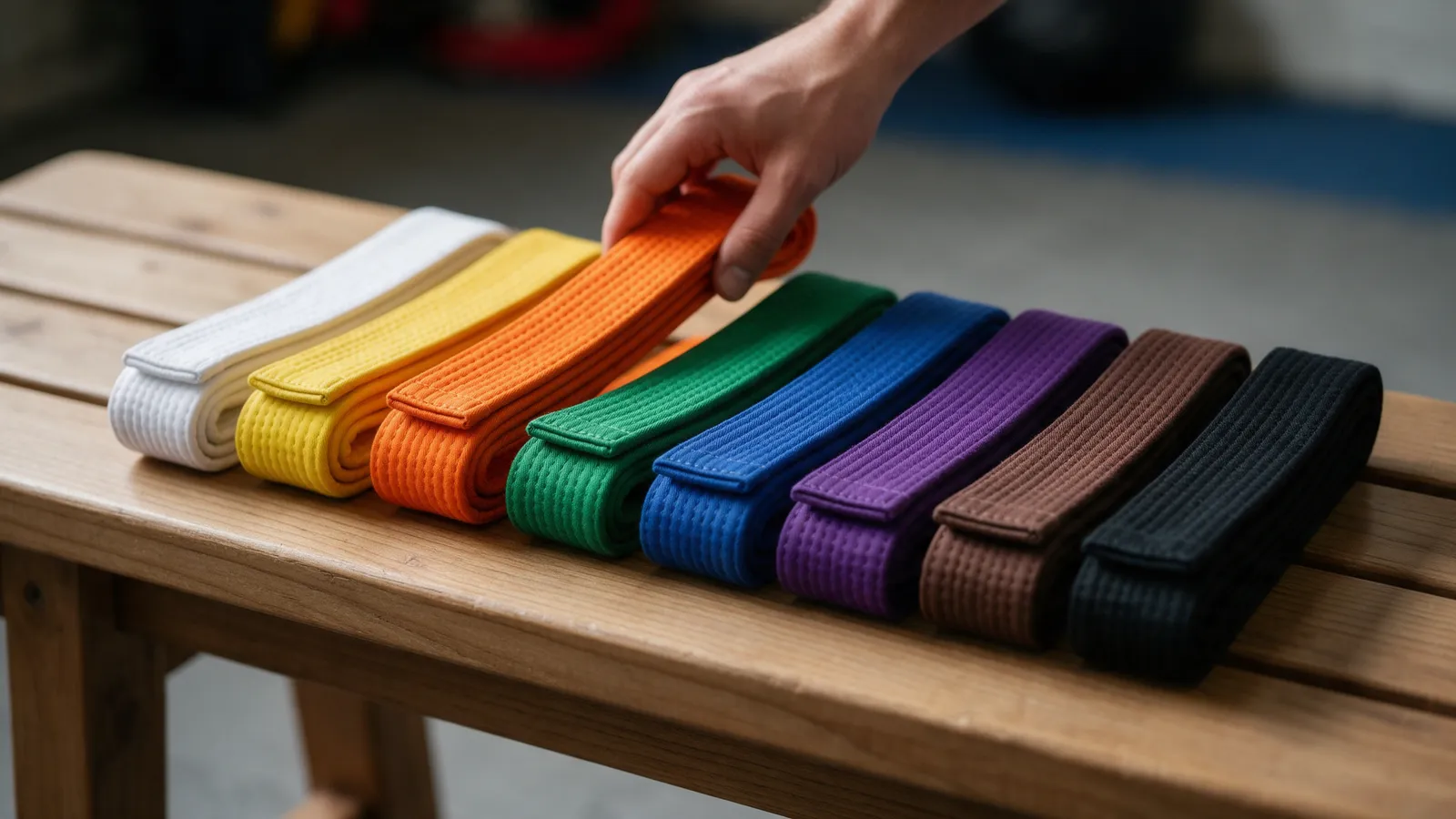
A belt at this club means something because it is hard to get and impossible to buy. The system is the association's, the examiners are three black belts who did not teach you that term, and the result is written on a mark sheet. This page and the gradings page set out exactly how it works, so that nothing about it is a mystery to a child or a parent.
The karate syllabus has ten kyu grades: white (tenth kyu), red, orange, yellow, green, purple, purple and white, brown, brown and white, and brown and two whites (first kyu), then shodan, the first black belt. Each has a minimum time in grade (three months at the lower kyu, six from green, a year at first kyu before shodan) and a syllabus of kihon, kata and kumite set out on the belt ladder on the gradings page. Children under twelve grade in a junior system with stripes between belts and junior black at the end.
Gradings are on Sunday mornings in the club, roughly every four months for each discipline, examined by a panel of three black belts that always includes one from another club in the association. Each grading has a fixed number of places, because a panel can only examine well so many people in a morning, and the places left are on the calendar. A dan grading is a two-day event at the association's regional centre.
Nobody books a grading for themselves. In the month before each one, the instructors put forward the students who are ready, and the club writes to those families with the date, the fee and what to prepare. A student who is not put forward is told why and what to work on; most are put forward next time. Pass rates are high because entry is selective, and a fail, when it happens, comes with a mark sheet and a retake at the next grading at no extra fee.
Kickboxing has a coloured-stripe syllabus graded twice a year; BJJ belts and stripes are awarded by Ffion and the affiliation's black belt at their visits, not at a formal grading, as is traditional in jiu-jitsu. The fees cover the panel, the belt and the certificate: £25 for a kids grading, £30 for an adult kyu, £120 for a black belt over two days.
What is included
- Ten kyu grades, white to brown, then dan grades for black
- A minimum time in each grade; the syllabus on the belt ladder
- Gradings on dated Sundays with a fixed number of places, shown on the calendar
- A panel of three black belts, always one from another club
- Entry only on the instructor's recommendation; a retake free after a fail
- Kids £25, adults £30, black belt £120, belt and certificate included
What it costs
A kids grading £25, an adult kyu grading £30, a black belt grading £120, the belt and certificate included. No joining fee and no contract. The timetable has every session with its spaces and the memberships side by side; the gradings page has the dates, the places left and the belt ladder.
Questions about the grading system
How often can my child grade?
Roughly every four months at the lower belts, if they are training at least once a week and the instructor puts them forward. Stripes on the belt mark progress between gradings so a child never goes months without something to show for it.
What happens if they fail?
They get a mark sheet saying exactly what to work on and retake at the next grading for nothing. It happens to a few at every grading, including some who go on to black belt, and the instructors are good at making it a lesson rather than a disaster.
Can we transfer a belt from another club?
Usually yes, after a few weeks of training so the instructor can see the grade is equivalent. Belts from the same association transfer directly.
Your first session is free. Bring a T-shirt and joggers.
Tell us who is training, how old they are and the discipline you are curious about, and we ring back the same evening with a session that has space. Train barefoot on the mats, ask the instructor anything afterwards, and decide then. Or ring the club.