Two programmes at home and on walks: an assessment, four follow-ups and messaging support, £320
Separation and reactivity
Two longer programmes for the problems that hurt dogs and owners most. Separation: a dog who cannot be left without barking, howling, destroying or soiling. Reactivity: a dog who barks, lunges or growls at other dogs or people on walks. Each is an assessment at home, a written plan, four follow-ups over three months and messaging support throughout, £320.
Separation distress and reactivity are both about fear, and fear is not fixed by correction. It is fixed by keeping the dog below the point where it panics and slowly, measurably moving that point. It takes weeks to months. It works. And it is far easier with someone checking the plan every fortnight.
Separation programmes start with an assessment at home and a recording: we ask you to film the dog alone for a few minutes, so we know whether the problem starts at the door, after ten minutes, or when you pick up your keys. The plan builds absences in seconds and minutes, never longer than the dog can cope with, with a camera so you can see, and with a plan for the hours in between (a dog walker, a sitter, day care) because the dog must not be left beyond its limit while the training happens. Most dogs can be left for a working morning within two to four months.
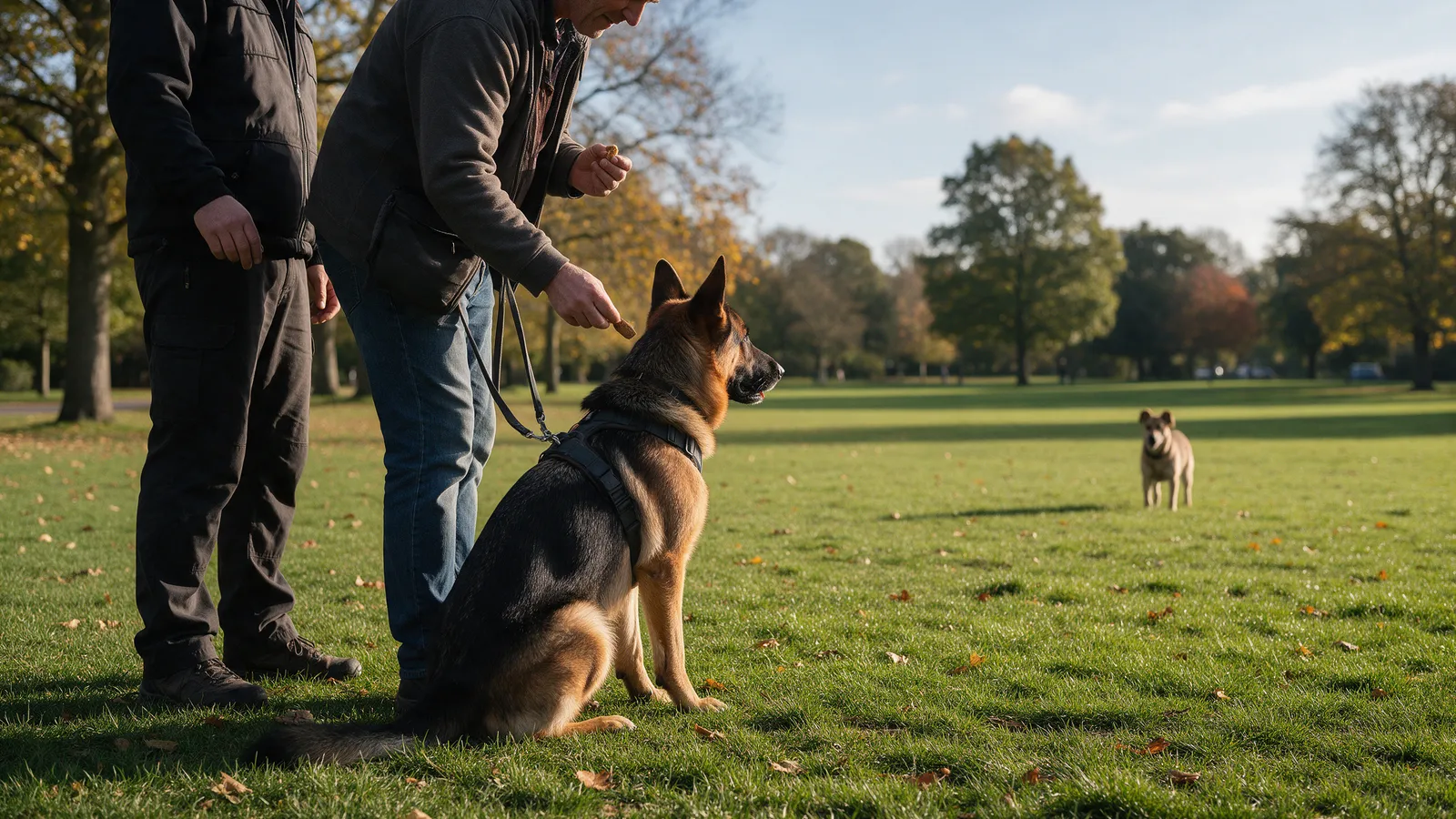
Reactivity programmes start the same way and then move to walks: we find the distance at which your dog can see another dog (or a person, a bike, whatever the trigger is) and stay calm, and we work there, rewarding calm looking, then slowly closing the distance over weeks. Owners learn to read the early signs, to choose routes and times, and to get out of a situation before it boils over. We use quiet corners of Heath Park at quiet times and, later, a calm stooge dog of ours, Bracken.
Both programmes have four follow-ups over about three months, at home or on walks, and messaging support throughout, usually with short videos back and forth. The written plan is updated after each follow-up. Where medication might help, we say so and work with your vet.
We are honest about what is realistic. Most separation cases improve enormously; a few dogs always need someone with them. Most reactive dogs become manageable and many become calm; few become dogs who love every other dog. We will tell you what we see at the assessment.
What is included
- A ninety-minute assessment at home, with a video of the dog alone or on a walk
- A written plan, updated after every follow-up
- Four follow-ups over about three months, at home or on walks
- Messaging support throughout, videos back and forth
- A calm stooge dog for reactivity work when the dog is ready
- Joint working with your vet where medication may help
What it costs
£320 for the programme: a ninety-minute assessment, a written plan, four follow-ups and three months of messaging support. No membership and nothing added. The timetable has every class with its spaces and every price side by side; the problem finder says which course or visit fits.
Questions about separation and reactivity
Will getting a second dog fix separation problems?
Rarely. Most dogs with separation distress are missing their person, not company in general, and you can end up with two distressed dogs. Work on the problem first; then think about a second dog for its own sake.
My dog is fine with dogs off lead but explodes on lead. Why?
Very common: on a lead the dog cannot move away, so it tries to make the other dog move away instead. It is usually fear or frustration, and it responds well to the distance work in the programme.
Is a muzzle cruel?
No. A well-fitted basket muzzle, introduced slowly with food so the dog likes it, is a safety tool that lets a reactive dog go to more places. We teach muzzle training as part of the programme where it is needed.
Tell us about your dog. We will say what fits, and what it costs.
Two minutes on the form: your dog, their age, what is going wrong. We reply the same working day with the course or visit that fits and the next date, or book a free ten-minute call if you would rather talk first. Or ring Ffion in the office.