From twelve weeks to three years, a parent in the water, thirty minutes in the warm teaching pool, £9 a lesson
Parent and baby
Thirty minutes in the 30°C teaching pool with your baby, from twelve weeks old to three years, in groups of eight parents with a teacher in the water: songs, floating, holding the wall, the first underwater swim if your baby is ready for it, and a lot of splashing. £9 a lesson, charged by the term.
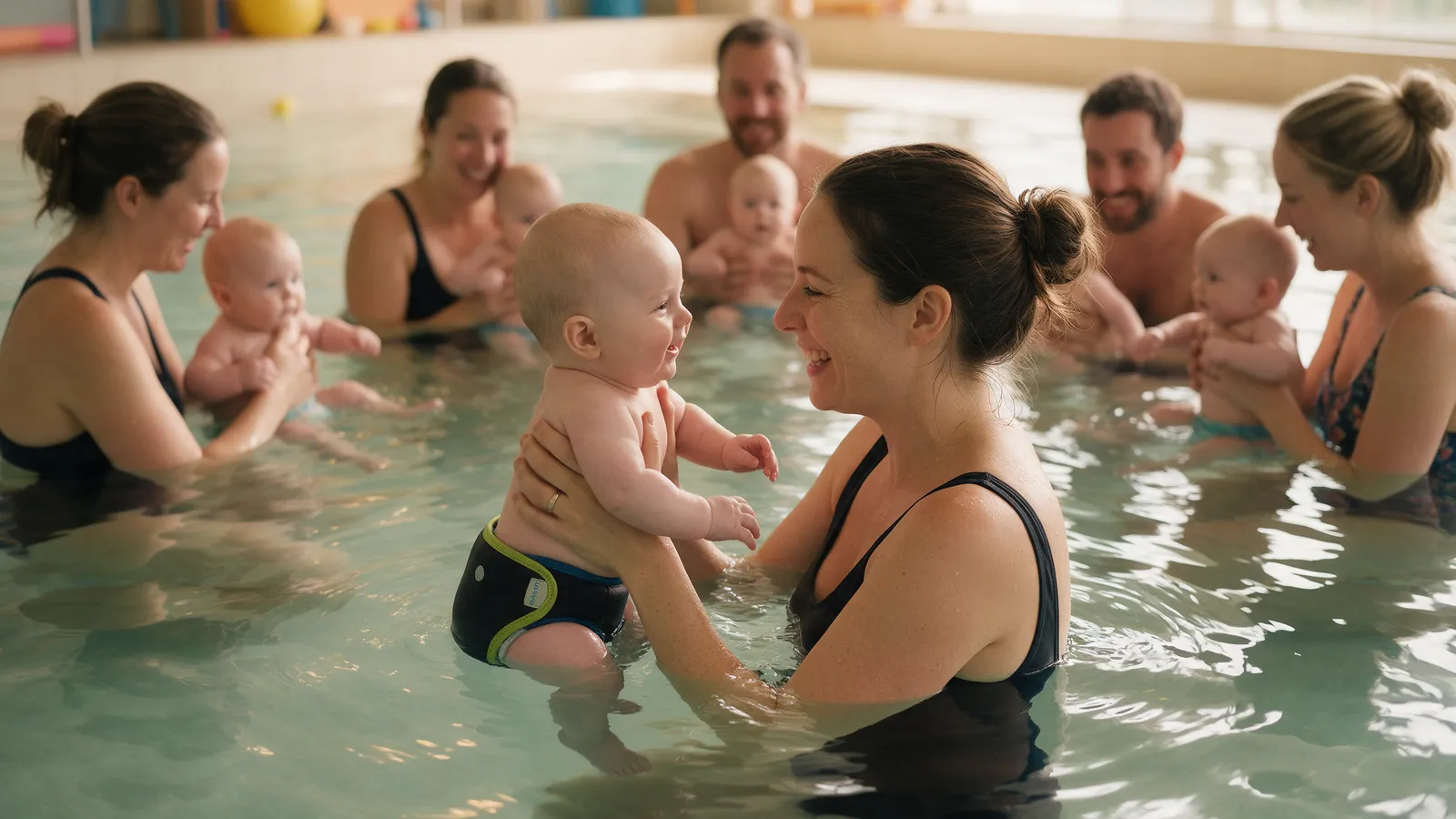
Baby swimming is mostly about the parent: learning to hold your baby confidently in the water, to read when they have had enough, and to make the pool a place they love. The swimming follows, in a year or two, from a child who has never once been frightened of it.
Classes are in the teaching pool at Llanishen, which is kept at 30°C and is shallow enough for every parent to stand. Babies start from twelve weeks; there is no need to wait for vaccinations, which the NHS confirmed years ago. Each class has up to eight parents with their babies and a teacher in the water demonstrating every hold and every song, and lasts thirty minutes, which is as long as a young baby enjoys.
The course follows the babies' development rather than a timetable. The early weeks are holds, floating on the back with your hands under the head, kicking with support, and the gentle face-wetting that teaches the breath-holding reflex. From about six months, those who are happy are taken briefly under with a cue word; nobody is submerged who is unsettled that day. From a year, it is walking along the step, jumping in from the side to you, reaching for the wall and turning back to it, and floating with a noodle.
At two, toddlers start to want to do it themselves, and the class shifts towards independence: getting out on their own, holding the wall unaided, kicking on a float. At three most move into the pre-school class without a parent in the water, which is the moment the whole of baby swimming is preparing for, and which most children take in their stride.
A swim nappy and a neoprene happy-nappy over it are compulsory, because the centre closes the pool if one fails. Changing mats are in the family changing room, and there is a bottle-warming corner by the poolside café. Siblings can watch from the viewing gallery with another adult.
What is included
- From twelve weeks to three years, with a parent or carer in the water
- The teaching pool at 30°C, shallow enough to stand
- Eight parents at most, a teacher in the water demonstrating
- Songs, holds, floating, the first underwater swim only when ready
- Weekday mornings and Sunday mornings
- £9 a lesson, charged by the term for the lessons left
What it costs
£9 a lesson, charged by the term for the lessons left. A happy-nappy is compulsory (we sell them at £8). Registration £15 once. The level finder suggests the stage and lists its classes with spaces; the term dates page shows the lessons left this term and what joining now costs.
Questions about parent and baby
Does my baby need their jabs first?
No. NHS advice is that babies can swim at any age, before or after their vaccinations. Most of our babies start between twelve weeks and six months, which is when the breath-holding reflex is easiest to work with.
Will my baby be put underwater?
Only if they are ready and you want them to be, briefly, with a cue word they have heard all term, from about six months. Plenty of babies never go under in our classes and are none the worse swimmers for it.
Can grandparents or a nanny bring the baby?
Yes, any adult who is comfortable in the water. Tell the office so we can put the right name on the register.
Find the stage, then book a place. Pay only for the lessons left.
Tell us the swimmer's age and what they can do now, and we offer a class at the right stage with a space, usually within the week. The first ten minutes are an assessment and the teacher moves them that day if the stage is wrong. Or ring Carys in the office.