Emergencies
If you are asking, ring.
Day or night, ring the emergency line and one of our own vets answers. They will tell you whether to come straight in, whether it can wait until morning, or what to do at home now. Daytime emergencies are seen the moment you arrive at no extra fee; out of hours is £160 on top of treatment, and you are told the likely total before you leave home.
What to do
Six steps, in order.
01
Ring 01632 960 813
Any hour. It rings the vet on duty directly, not an answering service. If it is engaged, ring again; they are on another call and will pick up.
02
Say what has happened
What the animal is doing, when it started, what they might have eaten. The vet decides with you: come now, come in the morning, or do this at home.
03
Hear the likely cost
Before you leave home, the vet tells you the out-of-hours fee and the probable cost of what is likely to be needed, so there is no surprise at the barn.
04
Drive carefully
A towel or blanket for a bleeding or frightened animal, a box for a cat, and someone else driving if you can. The car park lights come on and the door is open when you arrive.
05
Seen at the barn
By the vet you spoke to, with a nurse, in the rooms your pet knows. Theatre, x-ray and the laboratory are all available at night.
06
Home, or our ward
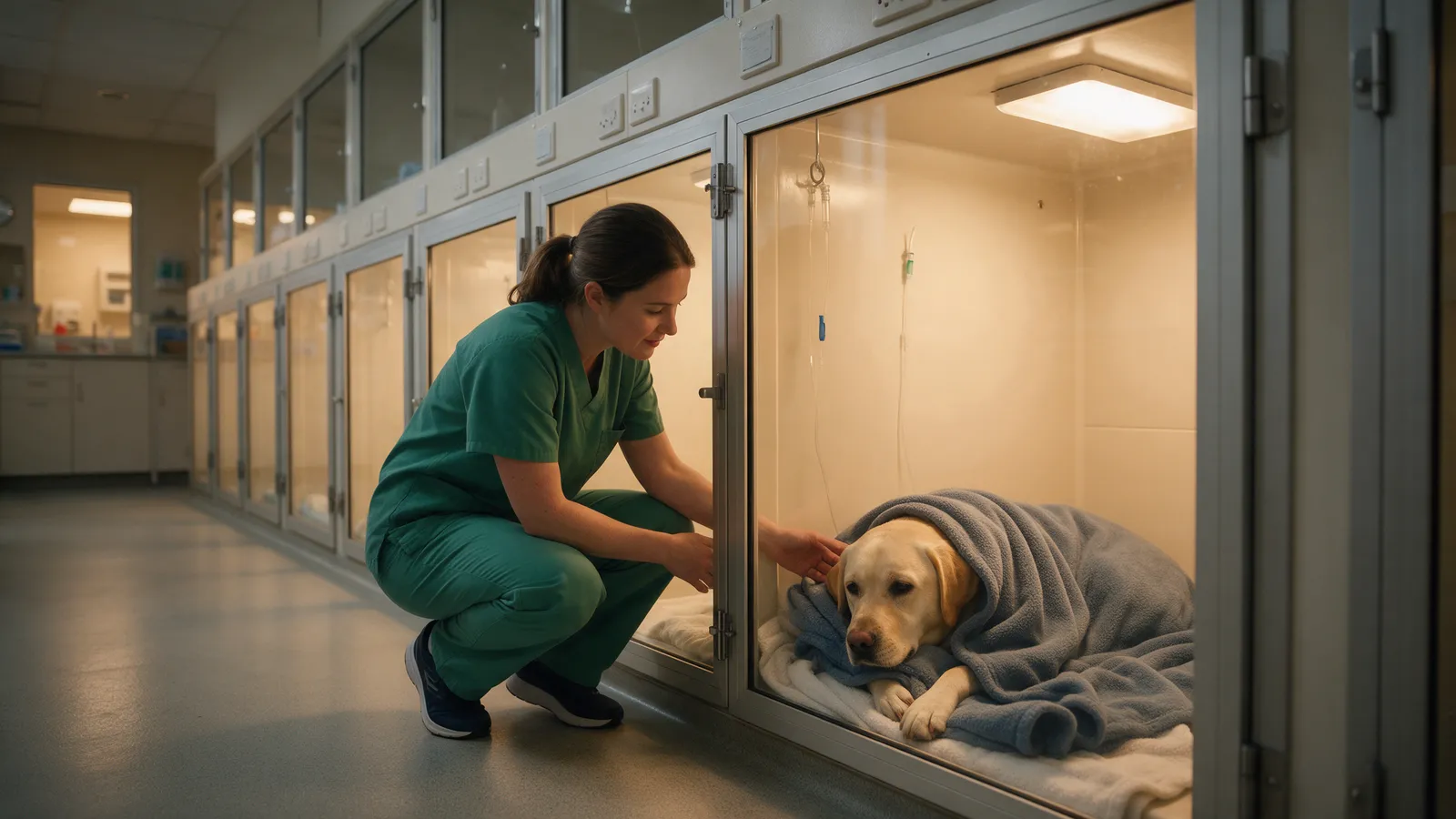
Most go home the same night with a plan and a call in the morning. Animals that need to stay are in our ward with a nurse checking, not transferred.
Cannot wait
The things that are always an emergency.
Difficulty breathing or blue gums. Collapse, or a seizure lasting more than three minutes. Uncontrolled bleeding. A dog with a swollen stomach that is retching without bringing anything up. A cat straining in the litter tray and producing nothing. A road accident or a fall, even if they seem fine. Poisoning: chocolate, grapes, raisins, lilies for cats, rat bait, antifreeze, xylitol in sugar-free sweets, human painkillers. A bitch or queen in labour for more than two hours without a puppy or kitten. A rabbit that has not eaten for twelve hours.
Things that can usually wait until the morning, with a phone call to check: a single vomit or loose stool in an otherwise bright animal, a limp that is not a dangle, a torn claw, a small cut that has stopped bleeding, an ear being scratched. When in doubt, ring: the vet would rather take a two-minute call than see an animal six hours too late.

Also
Poisons, insurance, and the cost of the night.
Common poisons
Chocolate, grapes and raisins, onions, xylitol, ibuprofen and paracetamol, rat bait, slug pellets, antifreeze, lilies (cats), daffodil bulbs. Bring the packet. Do not make them sick unless the vet tells you to.
What the night costs
£160 for the out-of-hours consultation, then treatment at the prices on the prices page. A typical night visit for a dog that has eaten something is £160 plus £120 to £200. You are told before you leave home.
Insured?
Most policies cover out-of-hours treatment and we claim directly from the big insurers, so you pay the excess and the consultation on the night and the rest is claimed. Bring the policy number if you can.
Daytime emergencies
Ring on the way and come straight in; you are seen the moment you arrive at the ordinary consultation price. Reception is trained to recognise the things that cannot sit in the waiting room.
Save the number now.
01632 960 813, any hour, answered by one of our own vets. Put it in your phone before you need it, and ring if you are asking yourself whether to ring.