The guide
What fails an MOT.
Roughly three cars in ten fail first time in the UK. Here are the ten reasons that account for almost all of them, what each one means, and what you can check yourself in the car park before you come.
The ten commonest failures
- 18%of failures
Lights and signalling
A blown bulb, a cracked lens or a headlamp aimed too high. The single biggest cause of failure in the UK and the cheapest to avoid.
Check yourself: Walk round with someone pressing the pedals and switches: headlights both beams, indicators, brake lights, reverse, fog, number plate lamp. - 13%of failures
Suspension
Worn bushes, leaking shock absorbers, broken coil springs. Valley roads and speed humps are hard on springs; we see a broken one most weeks.
Check yourself: Push down hard on each corner: it should settle in one bounce. Listen for knocks over bumps. A car that sits lower on one corner has a spring gone. - 10%of failures
Brakes
Pads below the limit, discs scored or corroded, a handbrake that will not hold on the roller, or fluid that has boiled. Tested on the rollers, not by feel.
Check yourself: A grinding noise, a pull to one side, a spongy pedal or a handbrake that needs ten clicks all mean a look before the test. - 7.5%of failures
Tyres
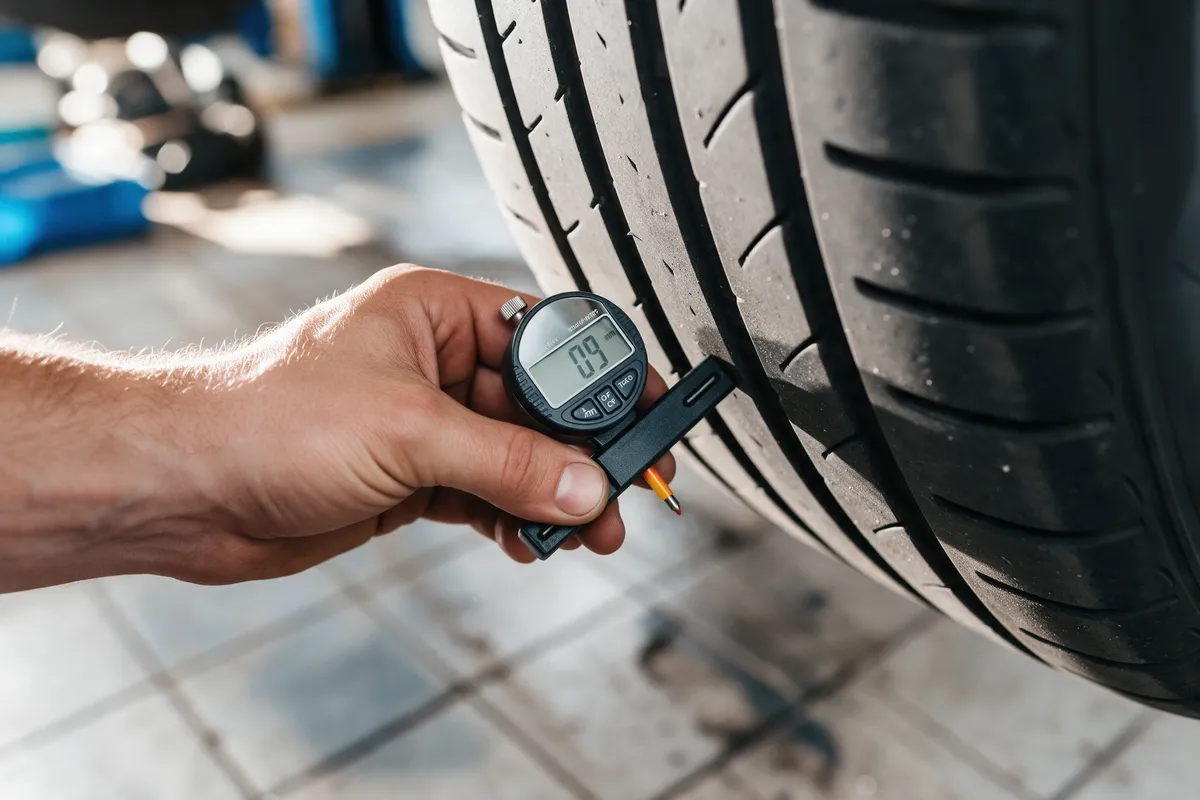
Tread under 1.6mm across the central three-quarters, cuts, bulges, or the wrong size on one axle.
Check yourself: Put a 20p coin in the groove: if the outer band shows, the tyre is at or under the limit. Check the inside edge, which wears first. - 7%of failures
Driver's view
Windscreen chips in the swept area larger than 10mm in front of the driver, worn wipers, an empty washer bottle, or things stuck to the glass.
Check yourself: Fill the washer bottle, replace split wiper blades, take the phone cradle and air freshener off the screen. - 5%of failures
Exhaust and emissions
A blowing exhaust, a missing catalyst, or a car that cannot meet the smoke or gas limits. Diesels with a removed particulate filter fail automatically.
Check yourself: A loud exhaust note or a smell of fumes inside the car. For diesels, a good run at motorway speed before the test helps a borderline emissions result. - 4%of failures
Steering
Play in the rack or track rod ends, a split gaiter, or a power steering leak.
Check yourself: Vibration through the wheel or a clunk when turning at low speed. - 3%of failures
Body and structure
Corrosion in a structural area, sharp edges from damage, or a towbar that is loose.
Check yourself: Look under the sills and around the suspension mounts. Surface rust is fine; holes and flaking in structural areas are not. - 2%of failures
Seat belts and airbags
A frayed belt, a buckle that does not latch, or an airbag warning light. The airbag light alone is a fail.
Check yourself: Pull each belt sharply: it should lock. Check the stalks click. If the airbag light stays on after starting, book diagnostics before the test. - 1%of failures
Number plates and VIN
Illegal fonts, spacing, tints or a missing plate. The DVSA tightened this in 2021 and we have to apply it.
Check yourself: Standard font, standard spacing, no "show" plates. If you are not sure, send us a photo.
Shares are rounded from published DVSA failure statistics for Class 4 vehicles and our own records; they move a little year to year but the order has not changed in a decade.
Five minutes before you leave
The car park checklist.
- All lights, including number plate lamp and rear fog
- Washer bottle full, wipers clearing properly
- Tyre tread with the 20p test, and pressures
- Horn works
- No warning lights on after starting: engine, ABS, airbag, power steering
- Mirrors intact, windscreen free of large chips
- Seat belts latch and lock
- Boot and cabin cleared so the tester can reach the seat belts and spare
Found something? Book the MOT anyway and tell us in the notes. Bulbs, wipers and most tyres can be done before the test so it passes first time, and you only pay once.
Common questions
Does an advisory mean it will fail next year?
No. An advisory is the tester's note that something is wearing and will need attention. Some advisories, like a tyre at 3mm, will almost certainly fail next year; others, like light corrosion, may not for years. We tell you which is which.
Can a warning light fail an MOT?
Yes. Since 2018 an illuminated engine management, ABS, airbag, electronic stability or power steering warning light is a major fault. Get it looked at before the test, not after.
My tyres are legal but you advised them. Why?
The legal limit is 1.6mm. Stopping distances in the wet get noticeably worse below 3mm, and a tyre at 2mm will not last to the next MOT. We advise at 3mm and explain why; what you do about it is your call.
Does a chipped windscreen fail?
A chip or crack larger than 10mm in the area in front of the driver (roughly the width of the wiper sweep on the driver's side) fails. Outside that area the limit is 40mm. Most chips can be repaired for less than the cost of a retest.
Book your MOT.
Pick a day and an hour slot online, or ring the desk. Car MOT £45, free retest, and you can watch it from the window.